The Fighter and The Firely
An Oral History of a Revolutionary Writer, by G.V.K Prasad | as told to Raaz, April 2025

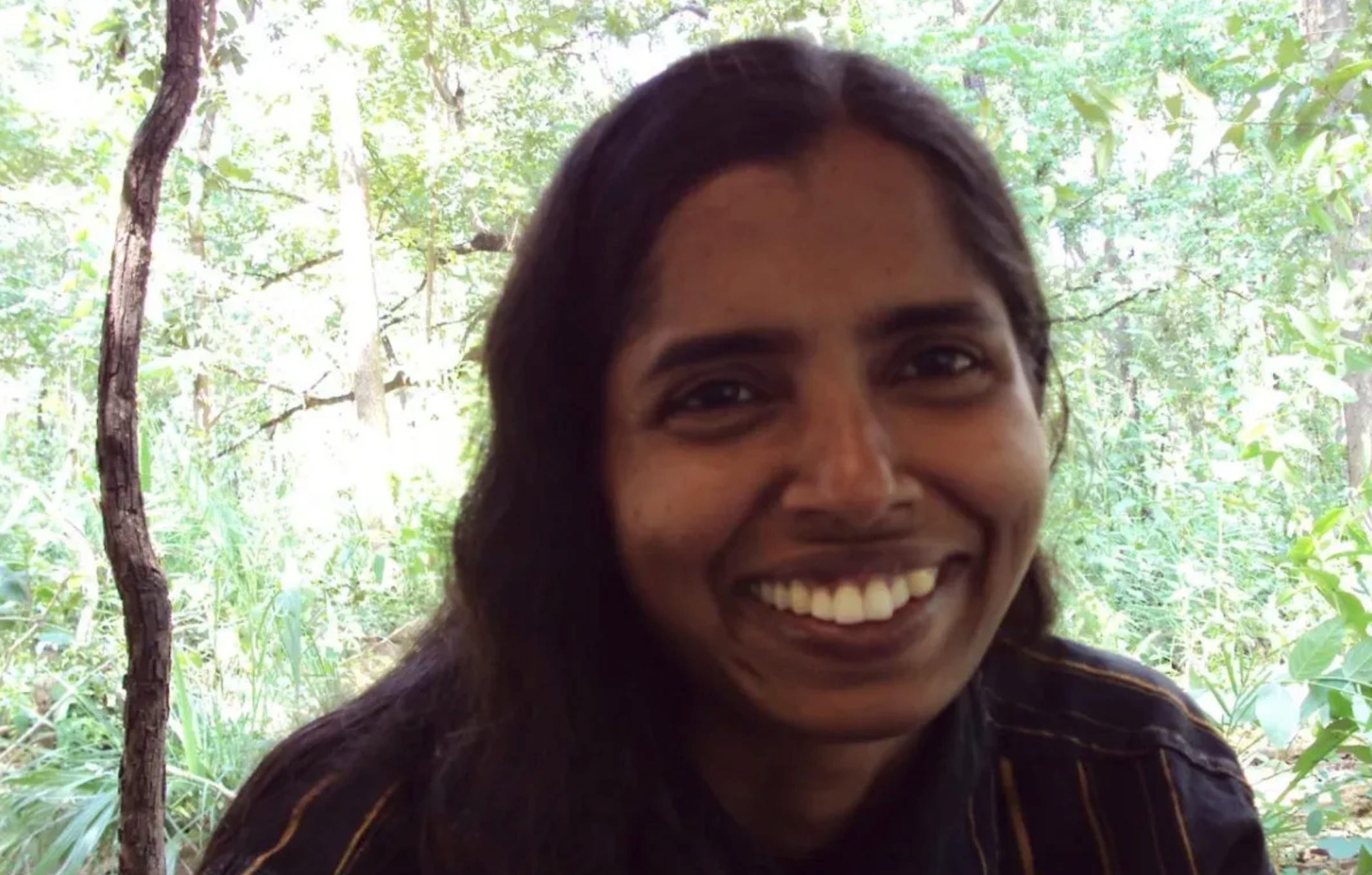
On March 31, 2025, Gumudavelli Renuka was assassinated in a State encounter while she was living in a village in Dantewada. At the time of her martyrdom she was the Press & Publication in-charge of Dandakaranaya Special Zonal Committee of the (banned) Communist Party of India (Maoist).
Read: Renuka's Fireflies | What Midko's stories tell us about life in the Liberated Zones
There was a column in front of the home where we grew up. We used to read the letters inscribed on it. We didn’t know what they meant at the time.
“In 1946 on July 4th, the goons of Ramachandra Reddy fired upon a man called Doddi Komoruyya. His memory will live forever.”
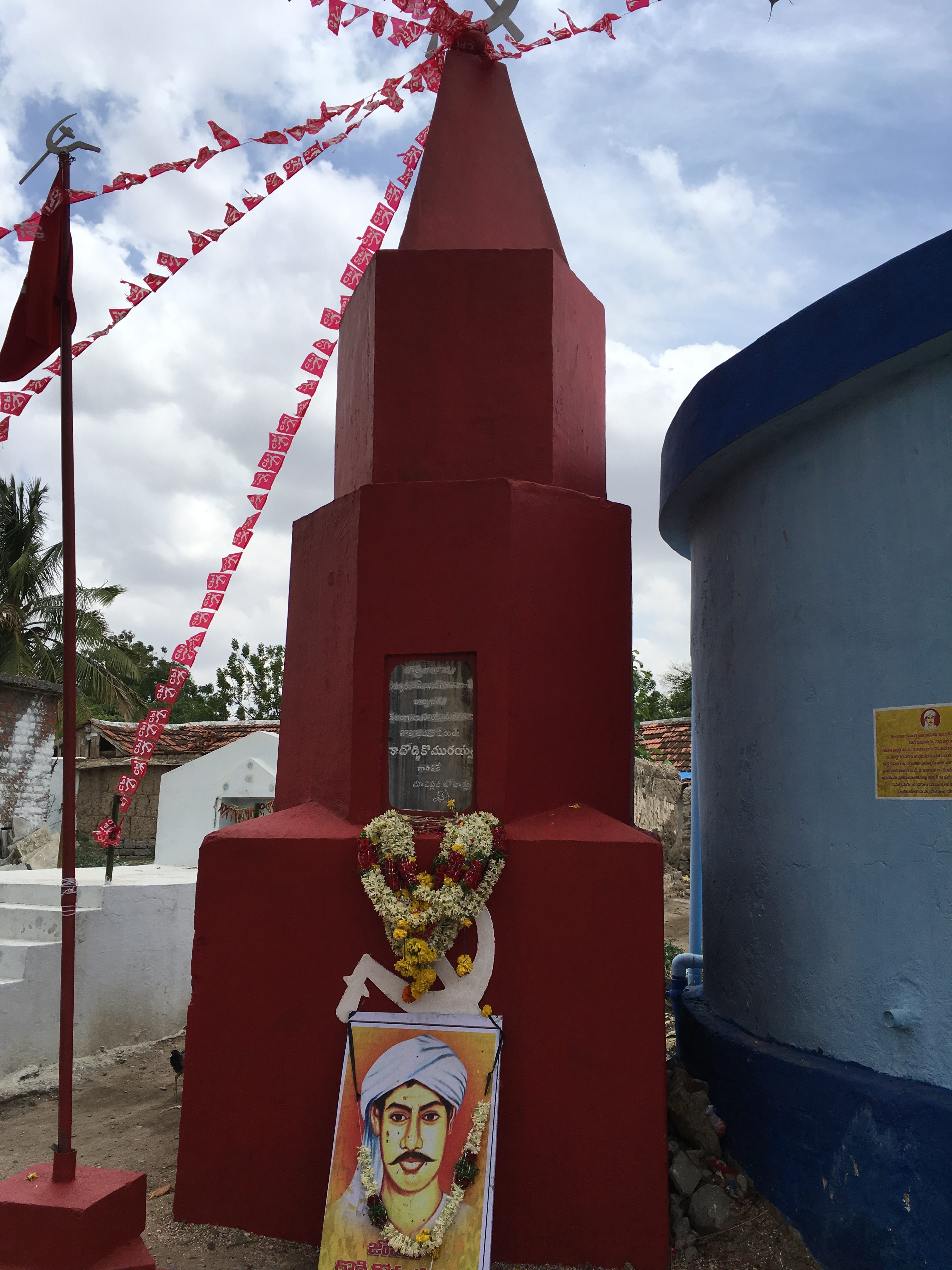
We grew up alongside red flags and revolutionary songs. It is only later that we understood that our village has a historical significance in Telangana, and the statue we passed by everyday on our way to school was of the first martyr of the Telangana Armed Struggle.
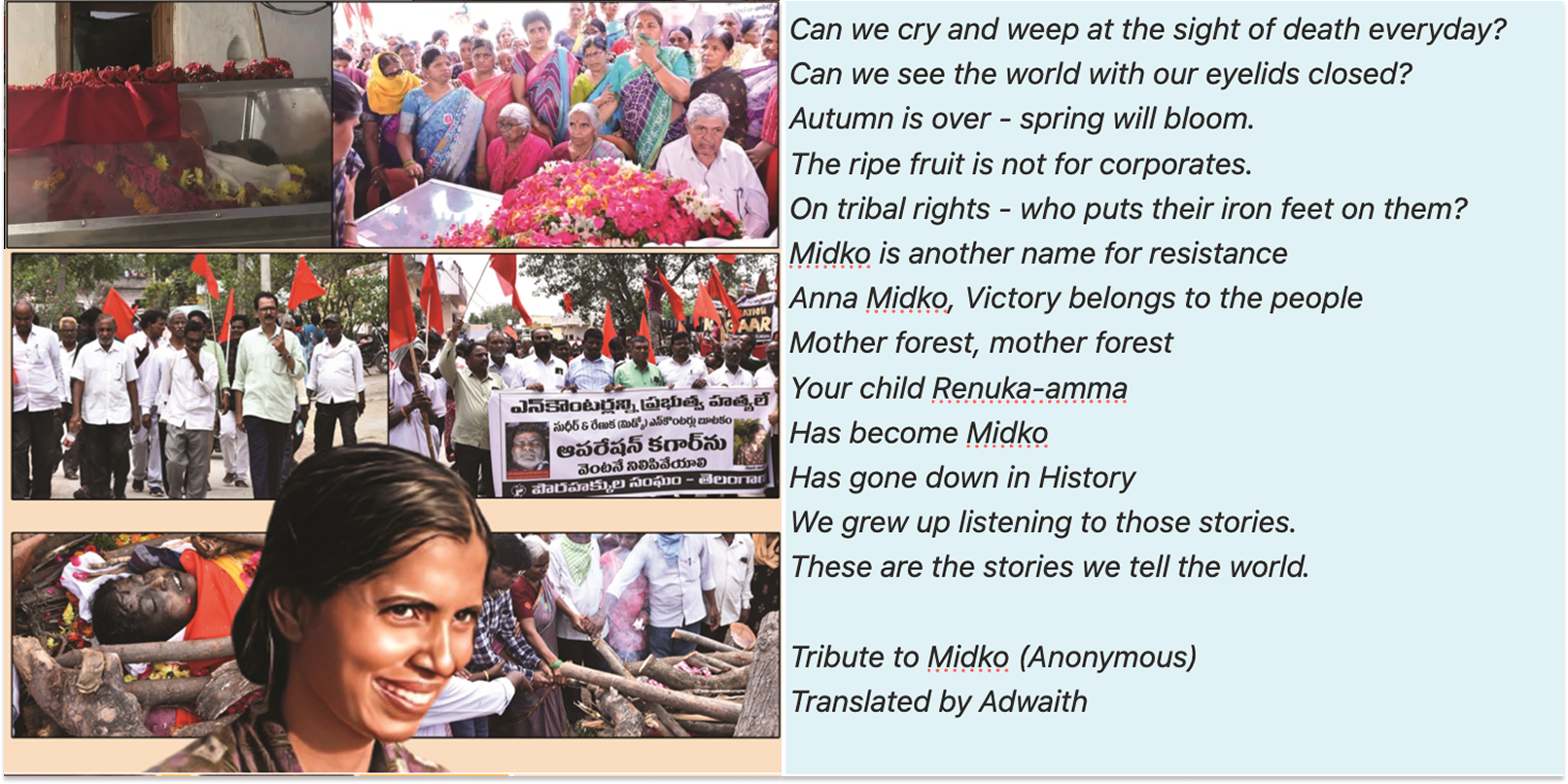
On April 2nd, 2025, this was the place where Renuka’s body was kept for public viewing.
Chapter One: Departure
There were three of us siblings: myself, Renuka, and Rajshekhar.
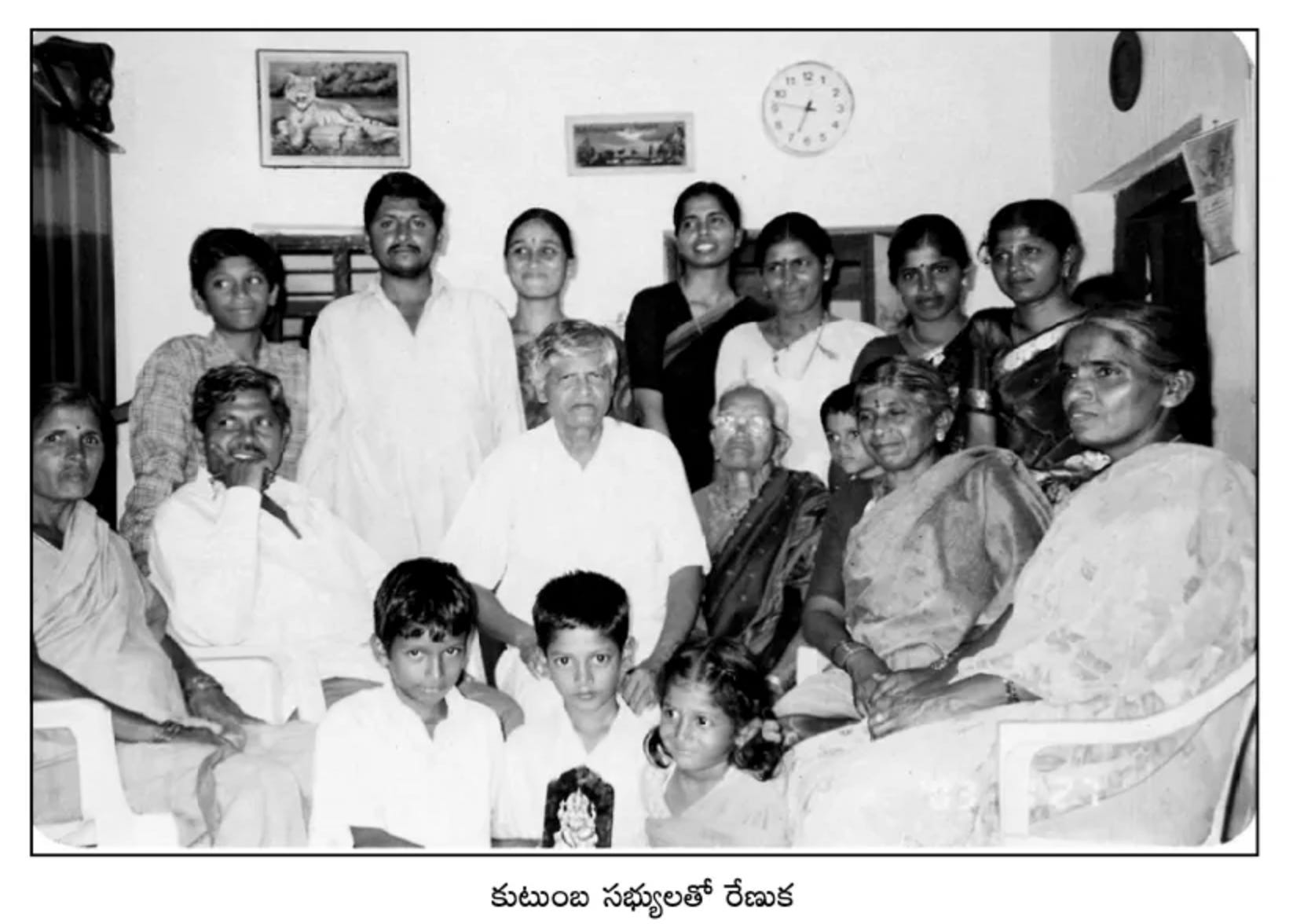
We spent our childhood moving from one village to another in the Warangal district. Our father was a schoolteacher, and every two or three years, his posting would change. We changed schools just as often— four or five times, by the time we finished high school.
I started activism at a very young age. When I was in my 9th class, I joined the RSU (Radical Students Union). When I was in 10th, we organised a strike in our school. We were debarred initially, but in the end we won that struggle.
At the time, Renuka was not as vocal. She was young, and she was a shy girl. She was good at studies, but physically she was never very fit. When she was in 10th, she got lungs TB. It took a very long time to get a correct diagnosis and get her treatment started. She almost died. Her treatment was very rigorous, for 120 days she had to take injections everyday.
In 1986, soon after finishing my intermediate (12th class), I left my home to work as a full-time activist with the RSU. I was arrested the next year, later released. But by then I had already crossed into a different world. I had no contact with my family. The life we shared disappeared.
Letter From Renuka
In 1992, Comrade Puli Anjanna (martyred in a 1993 encounter) travelled from Warangal to Bastar. He was carrying something for me - a letter from Renuka.
Renuka wrote to me about everything that happened since I left home. The police had been raiding our home in Kadavendi. They would arrive in the dead of night, at 2 a.m., 3 a.m., bang on the door and take my father outside, pressuring him to reveal my whereabouts. My family lived under constant fear.
I learnt that since 1989, my family had been living in Motkur. It was quieter there. The movement wasn’t as active, and the police were less aggressive. Around the same time, my father began pressuring Renuka to marry. She was reluctant, but with the weight of state surveillance and family strain pressing down, she finally agreed—on the condition that her in-laws would let her continue her studies.
But the man she married turned out to be violent. In our home, Renuka had never faced patriarchal abuse. We were raised in a democratic culture. She was never beaten, never silenced. What she experienced in that marriage was altogether new to her. She bore it for a while. In her own words, she didn’t want to put more stress on our already burdened parents. But at some point, it became too much.
One morning, she walked out, travelled to my parents' village, and told them everything.
This time, my family took a firm stand in support of her. They apologised for the marriage. They told her: you will not go back. No one can force you to.
Then, she was free. A free woman, a free person. She began studying seriously, not just academics, but also feminist literature. She was inspired by writers like Volga, whose Rajakeeya Kathalu (Political Stories) raise questions about family, marriage, and womanhood.
Renuka had been the object of patriarchal violence in her marriage. She had grown up observing landlordism in the villages and caste oppression in society. She began to question the connection between different forms of exploitation.
Was there a path that could resist patriarchy, class, and caste, and progress forward with a unified vision? This is what she wanted to ask me.
Meeting
In 1993, I travelled from the Abhujmarh jungles to Tirupati.
I had been told: there’s only one girls’ hostel. Tell the dean that you’re her brother—you’ll be able to meet her.
I reached the hostel and found a student near the entrance. I told her that I’m Renuka’s brother, and requested to her call Renuka outside.
A few minutes later, I saw someone walking toward me. I didn’t recognise her. She had grown tall. Older. Initially, I thought—this must be one of her friends, coming to say Renuka isn’t in the hostel.
She was also uncertain. She stopped maybe 50 or 60 metres away. She thought I was someone else’s brother, and it was all a mistake.
It was only when she came a few steps closer that I saw it. A curve in the centre of her forehead. The same as the one of my forehead.
That’s how we recognised each other.
We walked out from the hostel and sat down somewhere in a park nearby. We spoke for hours. It was the first time we had seen each other in nearly seven years.
Chapter Two: Midko
Read: Renuka's Fireflies | What Midko's stories tell us about life in the Liberated Zones
Padmakka
Padmakka worked in a mass organisation at Tirupati. She was a very senior comrade, an intellectual, a writer, and a fierce feminist.
In 1993, she knocked on the door of Renuka’s hostel and introduced herself. She mentioned Puli Anjanna — a name Renuka knew from my letter. That was enough to build trust. From there, the conversations began. They started discussing politics, feminist ideology, writing.
Padmakka became a role model for Renuka. Renuka started participating in Mahila Shakti programs and reading revolutionary literature.
She also began to write. Her stories Bhavukata, Marpu Yavarlo, and Ammakosan were published.
Padmakka shaped Renuka, even though they only interacted for a brief time. In 1994, Padmakka was killed in an encounter.
Fireflies
By 1995, Renuka took the decision of becoming a full-time activist (in party jargon, a PR – Professional Revolutionary). Like Padmakka. Like myself.
Through Padmakka’s spouse Krishnanna (a well-known leader in Nallamala jungles), she had come in touch with Party leaders who were working underground. Initially, the Party thought it was best to keep her in the cities for as long as possible. She worked aboveground as a writer, a lawyer, a Mahila Shakti activist, and an editorial member of Mahila Morgan magazine.
By the end of 1995, she began to write stories about the revolutionary movement. She also wrote stories under the names Nirmala, Zameen and Bhumika.
In 1999, my partner Sabita was killed in an encounter. She was a tribal woman from Gadchiroli area. Her name at home was Midko — ‘fireflies.’
Renuka never met her, but she knew her story. She inherited her name. This is how she started writing under the name Midko.
At the time, Midko was a word uncommon and unknown to Telugu readers. But her stories began to travel. Her stories were very much discussed, not just among readers of revolutionary writing, but among critics and readers of Telugu literature more broadly. Three of her stories — Metlameeda, Pravaham, and Iddaru Thallulu — were chosen among the best of the year by a panel that included Vasireddy Naveen and Papineni Sivasankar.
Chapter Three: Underground
In 2003, after the assassination attempt on Chandrababu Naidu in Tirupati, there was a massive manhunt across Andhra. All the mass organisation members were chased, hounded, arrested, tortured.
In early 2003, when my siblings were on their way to meet me, the police had apprehended them and tortured my brother. Renuka used her legal education to fight for his release from illegal detention. In that incident, a young girl named Damayanti was killed in police firing. Soon after, Renuka began writing under the name B.D. Damayanti.
Renuka was being followed. They were looking for the right moment to abduct her. But she acted smartly. She stayed visible, always among journalists, writers, public intellectuals. She left Visakhapatnam and went to Hyderabad.
In Janurary 2004, she broke away from her tail and went to Mumbai. She came in contact with Maharashtra Party comrades.
A few weeks later, she entered the forests of Orissa. From there, in Bansadhara, her underground life began.
A Revolutionary Writer
Bansadhara falls within the AOB (Andhra-Orissa Border) zone. That’s where Renuka first began her underground life as a Divisional Committee Member of the Party. She began learning Oriya and started writing in it too. She thought she might be there for many years.
But by 2006, the Party shifted her again, this time to Dandakaranya.
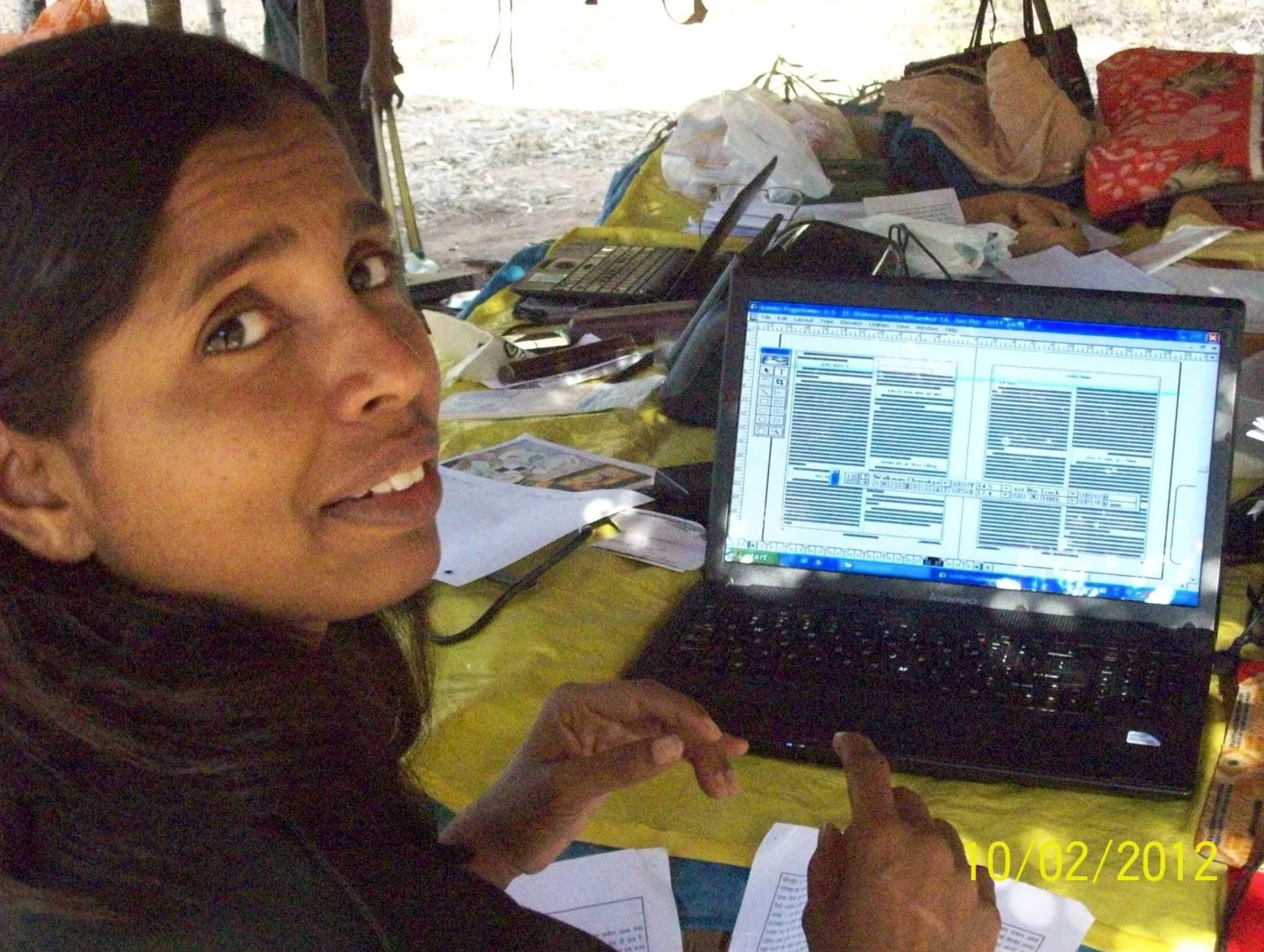
From the forests of Bastar, she wrote, edited, and managed Party magazine Kranti, under the leadership of Anand anna (martyred in 2023). But she contributed to every Party publication or magazine. Whenever a comrade needed a piece, she wrote for them. She never said no.
She was a very quick writer. Her language also needs to be mentioned. Telugu revolutionary literature, in my younger age, was very difficult to understand because it was full of jargon and big words and complex sentences. But we could see a clear breakaway in Renu’s writings. Her style was very simple, no big big adjectives or complexities. She would see things from a different angle, that is what made her stand out.
She wrote many reports under the name B.D. Damayanti. One of them, The Singanmadugu Report, was translated into English. Another, Haree Bharee Zindagi, was translated into Hindi - I was the one who translated it. The others stayed in Telugu: the Narayanpatna Report, Mandutunna Ghaayaalu.
Mandutunna Ghaayaalu (’Burning Wounds’) was a book of many interviews with victims of Salwa Judum atrocities. Gang rapes. Sexual violence. Humiliations. She wove together these testimonies together with great care and sensitivity.
The Singanmadugu was a short one, and written very quickly. Operation Green Hunt had just begun and villages had been raises by CoBRA forces. The Party was afraid for her safety, but Renuka insisted that she be allowed to go for fact-finding. She took on a daring mission of entering the villages and documenting the reports while the wounds were still fresh.
She had a brilliant journalistic mind. When she wrote Haree Bharee Zindagi, she only had a mini tape recorder and three cassettes. She would record everything, and in the night she would sit and take down all the notes. Then, she would wipe the tapes and use them again for recording the next day. This is how she did this fact finding for 10 days.
Thankfully for other reports she got some voice recorders. She had hundreds and hundreds of files in her voice recorders. She was very meticulous about keeping them in different folders, recording names of the villages, names of the victims, dates of interview, everything. She never said “people were killed” or “violence happened” – no, she was very specific. She was very fact-based in her reporting.
The Narayanpatna report was also a great one. It was a careful understanding of an entire movement: the contradictions that sparked the flame, the dispossession of Adivasi lands, the encroachment by outsiders, and the tensions between tribals and Dalits – all these things were discussed in different chapters. I hope one day it will be translated.
Chapter Four: Stories
Renuka had a story for every story. She was very observant and attentive of everything around her. The comrades, the villagers, our mother - all of them passed through her writing in some way.
She was quiet by nature. She spoke very little, and used language very carefully. She never used any unnecessary words. But though she was an introvert, she was very firm. She never hesitated to say if there was something wrong or express her disagreements.
This restraint and honesty is reflected in her writings also. If these stories were written by someone else, they may have taken the liberty of using descriptive adjectives or flowery metaphors. But the impact of her writing came from her thoughtful attention and measured intentionality.
Read: Renuka's Fireflies | What Midko's stories tell us about life in the Liberated Zones
Chapter Five: Encounter
I remember the name of the village called Belnar.
In the very first Whatsapp forward that came to me, the name of Renuka was mentioned in the very beginning. My eyes stopped there. I could not read the entire thing.
Initially, I thought it could be news of the previous day’s encounter in Sukma where 16 cadres were killed. I was not suspecting that Renu could be one of them. I knew she was in the Northern part of Indravati river, not in the South. I thought it might have been sent to me by mistake.
I called up Malini Subramanium. She was not in Bastar at the time, but she called someone in Dantewada. Then she called back and told me that there was an encounter, and that one woman died. “They’re saying it is Renu.”
Then I got a call from an unknown number. It was the Telangana SP. “Very sorry to tell you, but your sister has been killed.”
I asked if it is a confirmed news or if he was just suspecting that it could be her? He said it’s confirmed. Dantewada SP Gaurav Rai had told that she was living in a village with 2-3 security cadres. There was an encounter, and she was killed.
I was in the office at the time, actually. I told my editor I need to go out. I took a flight to Raipur.
Santoshi, my partner, is from Bastar, I went to her village first. Then there we hired a vehicle and traveled to Dantewada next morning.
This encounter…the pattern itself is revealing. Only a few days ago, one person was killed in an encounter. His photo was circulated through Whatsapp. The villagers denied that this was an encounter, saying that he was staying at a villager's home, he was picked up along with other villagers, and they all got shot.
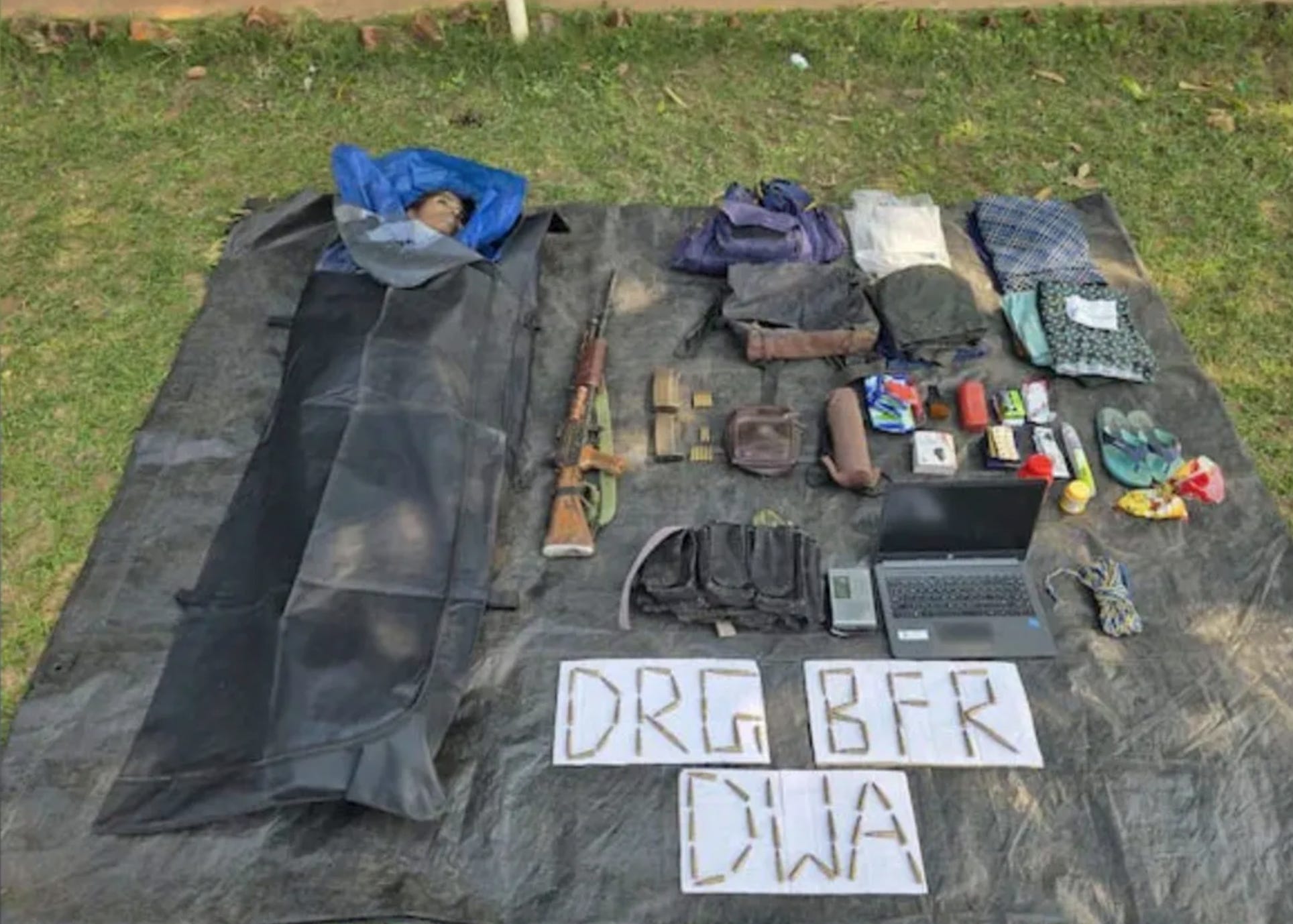
Then there are the things which were put on a polythene sheet. They were barely enough for one person – some clothes, very few medicines. They said there were 2-3 persons and they all left her and ran… even if they ran away, there should have been some materials related to them - their kitbags, their weapons, ammunition, clothes. Nothing was there.
There were 2-3 lungis visible in that picture. I know they were Renu’s lungis. 12 years ago also, she had those same lungis in her kitbag. My wife and I recognised them immediately.
That gun is not hers. She usually never carries a gun because of her ill health, her fitness problems, and her chronic spondylitis. She would always complain of back ache. If some guards who were there to protect her were carrying these weapons, why would they throw away their weapons and run away?
Corpse
At Dantewada, I spoke to a DSP-level officer. I asked him how such an incident happened where only one person, one weak lady alone was killed. He repeated the same story again - there were two teams protecting her, they all ran away. I didn't want to argue with him so I just kept quiet.
I did fight with the police to give us at least one item that they confiscated. They have us a saree from her kitbag. The saree and the blouse were all traditional tribal attire. I remember, the initial photograph they circulated of her showed a bindi and earrings. But she never wore these things when she was in the field. She must have been living in the village, as a villager, among the villagers, like an ordinary tribal woman, trying to keep herself alive in the midst of this horrific Operation Kagar.
We were not allowed to see her body before the postmortem. When I landed in Raipur around 6.30 or so, I called the DAG. He said the postmortem couldn’t happen today because there wasn’t any female doctor available at the hospital in the evening. He said I should come tomorrow at 9 o'clock.
We reached Dantewada in the morning. By the time the postmortem and panchnama was over, it was 2 o’clock. It was very hot.
I was taken by a cop to the mortuary where her body was kept. It was a tin shed surrounded by armed policemen. The freezer was not plugged in to electricity. I opened it and the body was stinking. A very foul smell was coming out. There were some bubbles coming out from her mouth. Looking at her face, I could not recognise her.
I could not uncover her body fully. To the extent I could see, her hands and some part of her chest…it was unbearable to look at her in that situation. I looked at her feet. Her feet were very much familiar to me. I can identify each of her toes.
That is how I told myself it is her, for sure, and no one else. It is Renuka.
My brother came with some relatives and villagers. They brought some clothes and an ambulance with a freezer. They later told me that when they tried to pull her up from the polythene to put her in clothing, they found her hands were already hanging, as if they could just fall down.
I mean there was no point to –
It was very unbearable, difficult, stressful, torturous to see her like that. They put her body in summer like that, for two days without any freezer. When the body was already decomposed, how can we identify which mark is bullet mark, which is a torture mark, which is result of careless handling of body?
We gave up. We just told ourselves we would give her a dignified farewell. There was no point in asking questions. I mean, who would listen to us?
Funeral
We entered Kadavend at 12:40 in the night.
The whole village was awake, nearly 1000-2000 people gathered at the entrance. Our three vehicles entered. They started throwing flowers on the ambulance. It was a very touching moment for us.
People came from every corner of both the Telugu states for her funeral. They threw flowers on her body, they raised slogans, they sang songs.
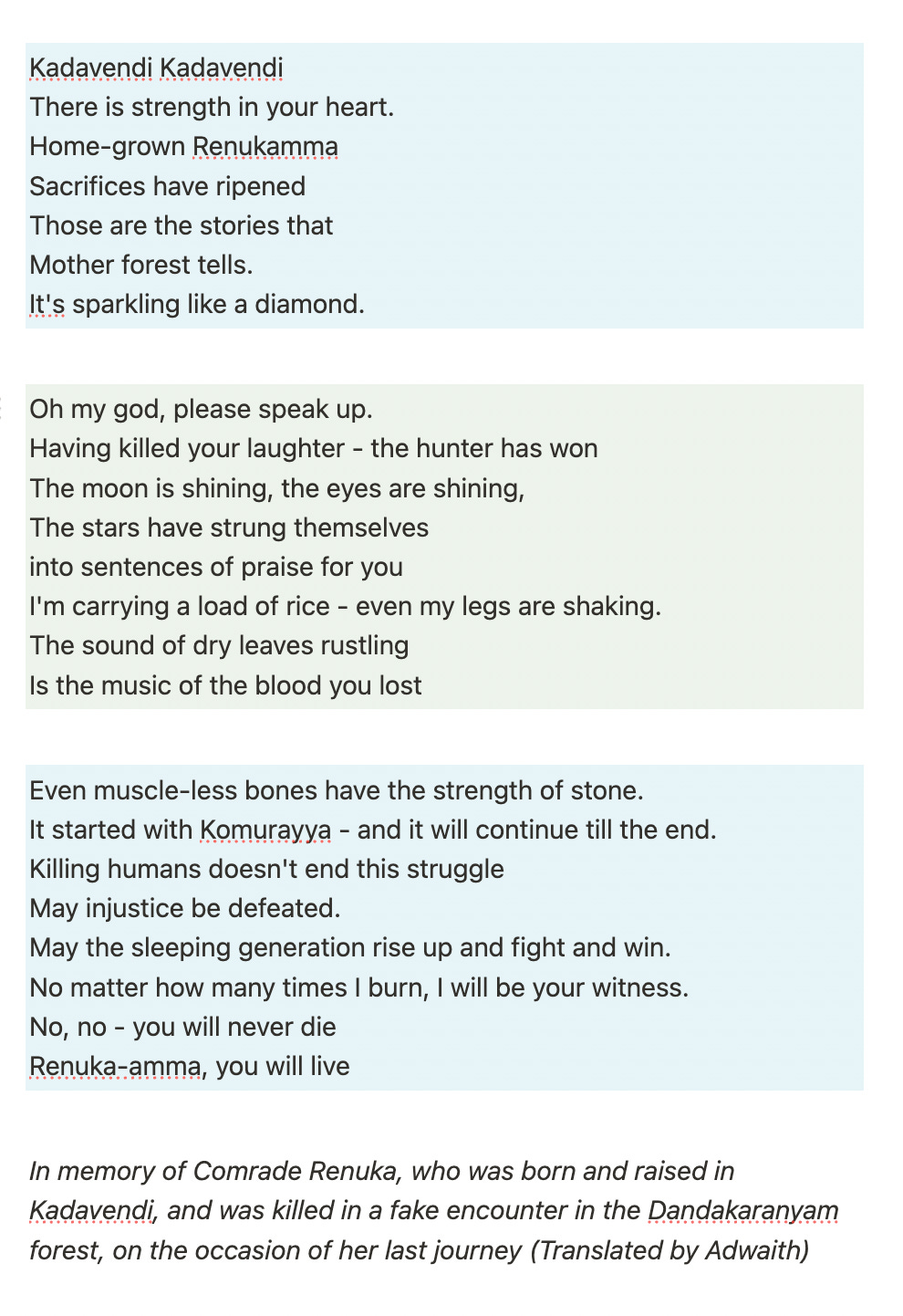
After funeral we brought out a booklet on her martyrdom, in which we compiled the poems and writings in her tribute.